Anxiety Therapists in Los Angeles — Evidence-Based CBT Treatment
Stop the Spiral.
Evidence-Based Anxiety Relief Starts Here.
CBT is faster and more effective than talk therapy.
Because weeks matter when you’re anxious.
Doctoral-level CBT psychologists.
Many are university faculty, so you’re treated with the latest science, not trends.
Begin your path to actual results.

Why Los Angeles’ Leading CBT Clinic Is
Trusted Across California for Anxiety Relief
2X
FASTER
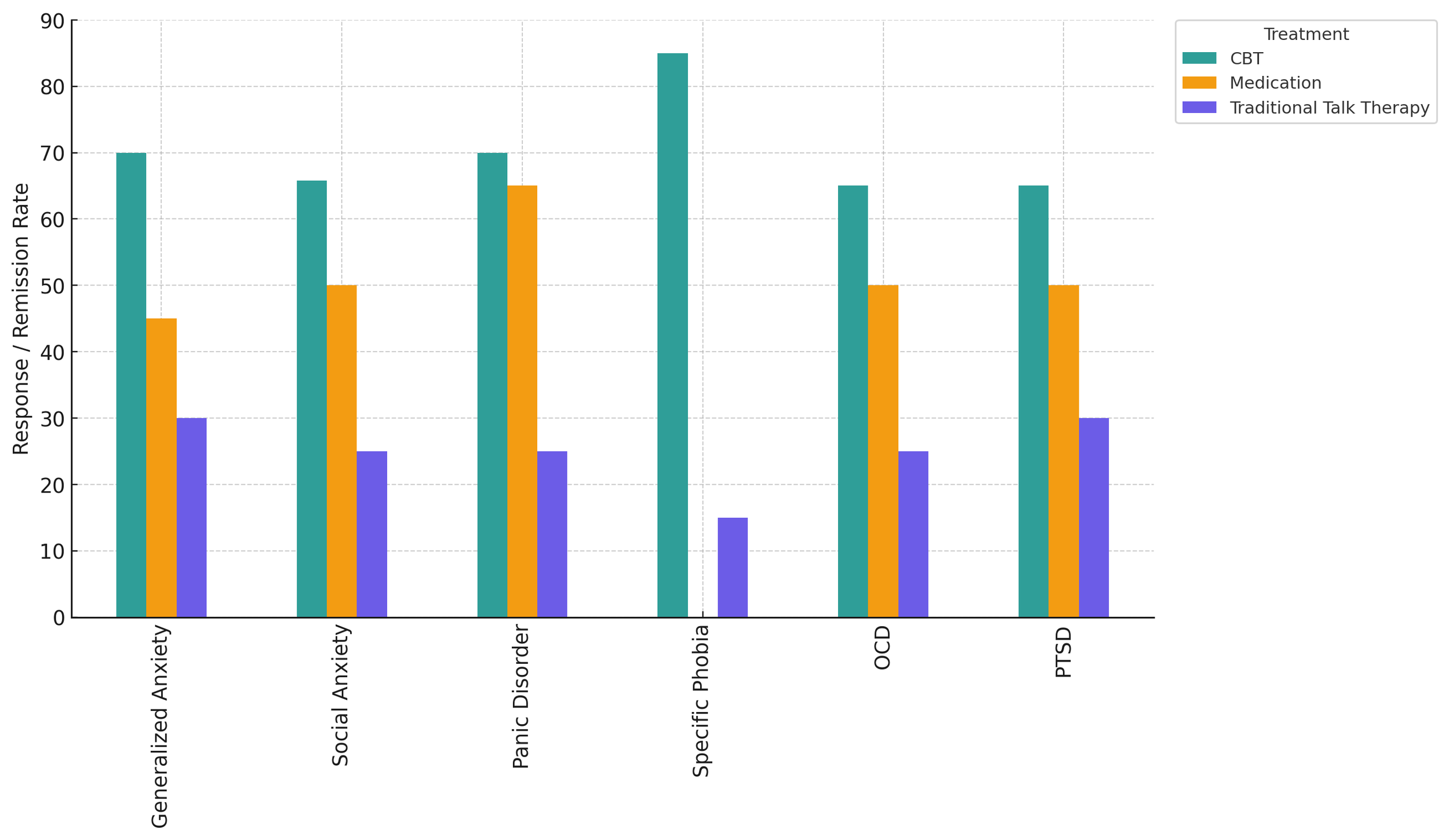
Most CBT clients experience relief from anxiety faster than talk therapy, usually within weeks, and often after session 1.*
2-3X
MORE EFFECTIVE
Early wins in CBT for anxiety triple the odds of full remission, often within the first few weeks.*
0
GUESSWORK
We track outcomes from day one, so you know how it’s working within the first month.
Our Psychologists Have Been Featured In

Treatment Effectiveness for Anxiety Disorders*
Take The First Step Toward Real Relief.
How Anxiety Takes Hold
By the time most people in Los Angeles search for an anxiety therapist, they have been managing the anxiety for months or years through some combination of avoidance, reassurance-seeking, and trying to think their way out of the worrying. The strategies work for a while. Then the anxiety adapts around them, and the next strategy has to do more work than the last one. Sleep gets worse. The body stays tense. Decisions that should be small consume an evening of analysis.
Anxiety responds to structured behavioral practice between sessions, not insight alone. What's missing in many prior attempts at treatment is the framework: a specific protocol for the specific kind of anxiety you have, delivered by a clinician trained in that protocol. CBT for anxiety has clinical-trial evidence across decades and across anxiety subtypes; the question for any individual is which protocol fits.
How We Treat Anxiety at Cognitive Behavioral Therapy Los Angeles

In your first one or two sessions, your psychologist works with you to clarify what kind of anxiety you have, what's driving it, what you've already tried, and what success would look like. Many people who arrive don't have a clear diagnosis; the assessment is usually the first place where the pattern is clearly named.
Treatment is calibrated to the specific anxiety subtype. Generalized anxiety (chronic worry across multiple domains) uses worry hierarchies, behavioral experiments testing the worry, and applied relaxation. Panic disorder uses interoceptive exposure (deliberate triggering of the physical sensations that panic mistakes for danger) combined with cognitive work on the catastrophic predictions about those sensations. Social anxiety uses behavioral experiments in real social situations, combined with social skills training and cognitive restructuring of the specific thoughts that make social interactions feel threatening. Phobias use paced exposure work calibrated to where you start. Health anxiety uses similar exposure work to bodily sensations and to the medical-reassurance behaviors that maintain the pattern.
All anxiety protocols share core elements: structured between-session practice, cognitive work on the specific predictions the anxiety is making, and graded exposure to whatever the anxiety has been getting you to avoid. The work is collaborative and paced; we don't ask you to do the maximum-difficulty version in session one.
You and your psychologist track progress with brief weekly questionnaires and concrete behavioral measures (specific situations entered, specific avoidance behaviors interrupted, anxiety ratings over time). If the work isn't moving by week four or five, the plan changes.
CBT for anxiety at CBT Los Angeles is typically structured around twelve to sixteen weekly sessions, depending on the subtype and the complexity of the presentation. By the end, you'll have a working set of skills specific to your kind of anxiety, a clearer understanding of what's been driving the pattern, and a written relapse-prevention plan.
If chronic anxiety has felt like a personality trait you have to live with rather than a clinical pattern that responds to treatment, the 15-minute consultation is built to test that.
Talk to an anxiety specialist to get a clear CBT game plan in minutes.
What to Expect
Sessions are 50 minutes, weekly to start. You can meet your psychologist in person at our Westwood/Brentwood office on Wilshire Boulevard, in our Pasadena office on South Marengo, or by telehealth from anywhere in California. Evening slots are available with most clinicians.
CBT LA is out-of-network for insurance. If you have PPO insurance, your plan likely reimburses 50 to 80 percent of the fee through the superbill we provide. We also accept HSA and FSA. Therapy is a real investment, and we treat it that way. The treatment is time-limited, the progress is tracked, and you'll know whether it's working.
Your first contact is a free 15-minute phone call. You’ll discuss what brings you in, the anxiety patterns you've been dealing with, and any prior treatment, so we can match you with the psychologist whose anxiety specialty fits you best. If what you need is something other than outpatient CBT for anxiety, we’ll tell you then and provide our best referrals.
Why Cognitive Behavioral Therapy Los Angeles for Anxiety

100% doctoral-level psychologists (PsyD/PhD)
Every clinician at CBT LA holds a PsyD or PhD in clinical psychology. All have specialized training in CBT for anxiety disorders and in the related protocols (applied relaxation, paced exposure, interoceptive work for panic, behavioral experiments for social anxiety). This isn't universal among LA practices that brand themselves as CBT specialists. Many staff members are a mix of doctoral and master 's-level clinicians, with most being master ’s-level therapists. With us, the doctoral anxiety-trained clinician is the one you work with from session one.
Structured CBT, calibrated to your own needs
We don't apply a single anxiety protocol to every client. CBT for Generalized Anxiety Disorder (GAD) looks different from CBT for panic disorder, which looks different from CBT for social anxiety. The assessment in the first sessions identifies which protocol (or combination) is the right starting point, and your psychologist adjusts if the protocol isn't making progress by week four or five. The framework is structured; the application is tailored to your unique needs.
Measurement at every session
Brief weekly questionnaires and session-by-session ratings show whether anxiety symptoms are decreasing in the areas you and your psychologist are working on. If the numbers stall, the plan changes. This is also how we know when treatment is complete, instead of letting sessions drift into open-ended check-ins after the work has finished.
If you want to know which anxiety protocol fits your specific situation, the consultation call is built for exactly that.
Stop Avoiding And Start Your Comeback Today.
Frequently Asked Questions
Does CBT actually work for anxiety?
Yes. CBT is the most-studied treatment for anxiety disorders, with decades of randomized trials across generalized anxiety, panic disorder, social anxiety, specific phobias, and health anxiety. It isn't a guarantee for any individual, but the evidence base for CBT applied to anxiety is among the strongest in psychotherapy.
How do I know what kind of anxiety I have?
The assessment in the first one or two sessions is designed specifically for that. Many people arrive without a clear diagnosis; the assessment clarifies whether what you're dealing with is GAD, panic, social anxiety, a specific phobia, health anxiety, or some combination. Your CBT therapist then tailors the treatment protocol to what's actually happening.
I've tried meditation, anxiety apps, and self-help books. How is CBT different?
Self-help approaches can be useful for psychoeducation and for mild anxiety. They generally don't address chronic anxiety because the underlying patterns (avoidance, reassurance-seeking, cognitive habits) operate below the level of conscious effort and require structured practice in real situations to update. CBT works with similar material the books point at, with the structure and the clinician oversight that allow the work to land.
Will I need to be on medication for my anxiety?
Some people benefit from medication, and some don't. CBT for anxiety has evidence comparable to medication for many clients, and the benefits of CBT tend to persist longer after treatment ends; medication’s benefits often end when the medication is discontinued. The consultation call is a good place to think through whether to pursue CBT alone, medication alone, or both; if medication is part of the answer, we refer to Los Angeles psychiatrists who work with adult anxiety.
What if outpatient CBT isn't enough for the level of anxiety I'm dealing with?
We'll tell you on the consultation call. Sometimes, more intense anxiety concerns may need more intensive treatment (IOP, PHP, or specialized programs), and we know providers across Southern California. We'd rather refer you to the right provider at the beginning than start outpatient treatment that isn't matched to what your situation needs.
Start With a Free 15-minute Call
Anxiety has a way of making the call to schedule a consultation feel like its own anxious event. The 15-minute consultation is built to be the smallest possible decision. You'll speak with our Practice Coordinator. She'll listen, answer what you want answered, and match you with the right doctoral psychologist at our Westwood, Pasadena, or telehealth practice. There's no charge and no obligation to schedule anything else.
If outpatient CBT for anxiety isn't what you need, we'll tell you that too and help you find what fits.
Stop Letting Anxiety Set The Agenda.
Claim Your First Step Toward Calm And Reserve A Consultation This Week.
CBT For Specific Anxiety Disorders
Explore the links below to see how CBT can help you with your specific anxiety problems.

Social Anxiety

Panic Disorder

PTSD

Phobias

Generalized Anxiety
Insomnia

OCD
Start Feeling Better This Week: Same-Week Appointments Available

Medically Reviewed by Albert Bonfil, PsyD.
Updated June 2026.
*Sources for Research Cited
Beck, A. T., Sokol, L., Clark, D. A., Berchick, R., & Wright, F. (1992). A crossover study of focused cognitive therapy for panic disorder. American Journal of Psychiatry, 149(6), 778–783. https://doi.org/10.1176/ajp.149.6.778
Hellström, K., Fellenius, J., & Öst, L.-G. (1996). One versus five sessions of applied tension in the treatment of blood phobia. Behaviour Research and Therapy, 34(2), 101–112. https://doi.org/10.1016/0005-7967(95)00060-7
Leichsenring, F., Salzer, S., Beutel, M. E., Herpertz, S., Hiller, W., Hoyer, J., Huesing, J., Joraschky, P., Nolting, B., Poehlmann, K., Ritter, V., Stangier, U., Strauss, B., Stuhldreher, N., Tefikow, S., Teismann, T., Willutzki, U., Wiltink, J., & Leibing, E. (2013). Psychodynamic therapy and cognitive-behavioral therapy in social anxiety disorder: A multicenter randomized controlled trial. American Journal of Psychiatry, 170(7), 759–767. https://doi.org/10.1176/appi.ajp.2013.12081125
Öst, L.-G., Alm, T., Brandberg, M., & Breitholtz, E. (2001). One vs five sessions of exposure and five sessions of cognitive therapy in the treatment of claustrophobia. Behaviour Research and Therapy, 39(2), 167–183. https://doi.org/10.1016/S0005-7967(99)00176-X
Öst, L.-G., Brandberg, M., & Alm, T. (1997). One versus five sessions of exposure in the treatment of flying phobia. Behaviour Research and Therapy, 35(11), 987–996. https://doi.org/10.1016/S0005-7967(97)00077-6
Parsons, E. M., Ball, T., Carl, J., Henry, A. L., Emsley, R., Miller, C. B., Wong, E. Y., Coombs, E., Collins, D., Long, L. J., Chis Ster, A., Smits, J. A. J., & Otto, M. W. (2025). Digital cognitive behavioral treatment for generalized anxiety disorder: A randomized clinical trial. JAMA Network Open, 8(12), e2548884. https://doi.org/10.1001/jamanetworkopen.2025.48884
Telch, M. J., Lucas, J. A., Schmidt, N. B., Hanna, H. H., Jaimez, T. L. N., & Lucas, R. A. (1993). Group cognitive-behavioral treatment of panic disorder. Behaviour Research and Therapy, 31(3), 279–287. https://doi.org/10.1016/0005-7967(93)90026-Q