Does CBT Work?
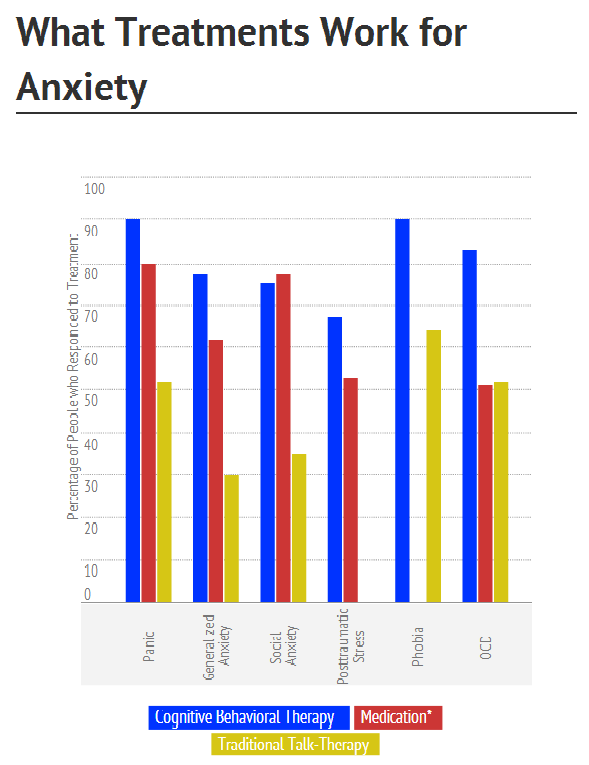
* For all disorders, discontinuation of medication led to a significantly higher relapse rate.
Yes: cognitive behavioral therapy is one of the most extensively researched psychotherapies, with hundreds of clinical trials supporting its effectiveness for anxiety disorders, depression, OCD, insomnia, and other conditions. Meta-analytic reviews consistently find strong effects, treatment courses are typically shorter than traditional therapy, and gains tend to hold up well after treatment ends: a key advantage over medication alone, where relapse after discontinuation is more common.
For most of psychotherapy's history, "does it work?" was considered almost rude: outcomes were private, progress was subjective, and comparing therapies was somewhere between impolite and impossible. The evidence-based practice movement changed that: therapies would be tested the way medications are, in controlled trials, against comparison treatments, with measured outcomes. It was a standard that carried real risk for the field, and CBT is, to a large degree, the therapy that thrived under it. What follows is what that research actually shows, including the comparisons, the numbers' limits, and the criticisms.
Over the last few decades, as psychology has moved toward evidence-based practice, a flood of research has emerged to guide clinicians and patients toward well-supported treatments. In study after study, Cognitive Behavioral Therapy performs strongly across numerous mental health conditions, and CBT treatments are usually shorter in duration, with results that endure well after therapy ends.
How Effective Is Cognitive Behavioral Therapy?
The research base is unusually deep: CBT has been evaluated in hundreds of randomized controlled trials, summarized in large meta-analytic reviews; you can examine the research on CBT across disorders in the review of meta-analyses linked as CBT with other disorders here. Across that literature, CBT shows reliable, clinically meaningful effects for anxiety disorders, depression, and a long list of related problems, with especially strong support where avoidance and distorted appraisals drive the condition. No credible reading of the evidence supports a promise that any therapy works for everyone, but as a bet made in advance, CBT's odds are as well-documented as any in mental health care.
How Does CBT Compare With Other Anxiety Treatments?
Three comparisons matter most. Against traditional open-ended talk therapy, CBT typically achieves its results in less time, because treatment targets the specific loops maintaining the problem rather than exploring broadly. Against medication, the acute results are often comparable for anxiety and depression, but the durability differs: medication's benefits generally require continuing the medication, while CBT's benefits persist after treatment ends, because the patient keeps the skills. Relapse rates after discontinuation consistently favor CBT in the research on this comparison. And combined approaches, CBT plus medication, are sometimes the right call for severe presentations, a decision to make with a prescriber. For anxiety specifically, exposure-based CBT is a first-line recommendation in clinical practice guidelines; see our Evidence-Based Treatment for Anxiety.
CBT Success Rates by Condition
Headline "success rates" vary by disorder, by how success is measured, and by study, which is why honest answers come as ranges and sources rather than a single number. The strongest, most consistent CBT outcomes cluster in the anxiety disorders (panic disorder, social anxiety, and specific phobias, where exposure-based protocols regularly help a substantial majority of completers) and in insomnia, where CBT-I is the recommended first-line treatment in clinical guidelines. For depression, CBT performs comparably to antidepressants acutely, with better relapse protection. And for obsessive-compulsive disorder, exposure and response prevention is the best-supported psychological treatment available, the approach our psychologists use in OCD treatment in Los Angeles. Where a specific figure matters to your decision, ask for the study behind it; numbers without denominators are marketing, not evidence.
The Criticisms, and What They Get Right
CBT's rise drew fire, most prominently from psychodynamic clinicians who argue it oversimplifies problems and chases a "quick fix." The fair version of the critique: not every difficulty reduces to thought-and-behavior loops, symptom measures don't capture everything people want from therapy, and a poorly delivered manualized treatment can feel mechanical. The evidence-based reply: shorter and structured is a feature when it works; and durability data suggest CBT's changes are not superficial. The mature conclusion is fit, not tribalism: CBT is the well-supported default for the conditions above, and a thoughtful clinician matches treatment to person, not person to treatment.
What "Effective" Means, and Doesn't
Effectiveness statistics describe groups, not individuals: no therapy works for everyone, outcomes depend on fit, severity, and the work done between sessions, and "effective" in research means measurably improved: not cured, and not guaranteed. What the numbers do justify is expectation-setting: with CBT, you should see a clear plan early, measurable movement within a defined arc, and course corrections if progress stalls. That accountability, the same standard that produced the research, is reasonable to demand from any treatment you invest in.
Quick Facts About CBT Effectiveness

• CBT's evidence base spans hundreds of randomized controlled trials, summarized in large meta-analytic reviews covering anxiety disorders, depression, OCD, insomnia, and more.
• CBT's gains tend to persist after treatment ends, and relapse after discontinuing CBT is generally lower than after discontinuing medication alone, per comparative outcome research.
• Exposure-based CBT and CBT-I are first-line recommendations for anxiety disorders and insomnia respectively in major clinical practice guidelines.
• Effectiveness figures are group statistics: they justify confidence in the approach, not guarantees for any individual course of treatment.
FAQ
Does CBT actually work?
For the conditions it's designed for (anxiety disorders, depression, OCD, insomnia, and others) yes, with support from hundreds of clinical trials. Individual results vary with fit, severity, and practice between sessions.
What is the success rate of CBT?
It depends on the condition and the definition of success; research reports ranges rather than one number, with the strongest outcomes in exposure-based treatment of anxiety disorders and CBT-I for insomnia. Treat any single universal percentage with skepticism and ask for its source.
Is CBT more effective than medication?
Acutely, they're often comparable for anxiety and depression; over the long term, CBT's advantage is durability, skills persist after sessions end, while medication benefits generally require staying on the medication. Combined treatment is sometimes best for severe presentations.
Why is CBT considered so effective?
It targets the specific mechanisms maintaining a problem, teaches transferable skills, and was built and refined inside the clinical-trial tradition, so its methods have been repeatedly tested and corrected against measured outcomes.
References
Barlow, D.H., Gorman, J.M., Shear, M.K., & Woods, S.W. (2000). Cognitive-behavioral therapy, imipramine, or their combination for panic disorder: A randomized controlled trial. Journal of the American Medical Association, 283, 19, 2529-2536.
Bradley, R., Greene, J., Russ, E., Dutra, L., & Westen, D. (2005). A multidimensional meta-analysis of psychotherapy for PTSD. American Journal of Psychiatry, 162, 214-227.
Choy, Y., Fyer, A.J., & Lipstiz, J.D. (2007). Treatment of specific phobia in adults. Clinical Psychology Review, 27, 266-286.
Craske, M.G. & Barlow, D.H. (2008). Panic disorder and agoraphobia. In D.H. Barlow (Ed.) Clinical handbook of psychological disorders: A step-by-step treatment manual. (4th ed., pp. 1-64). New York: Guilford Press.
Eng, W., Roth, D.A., & Heimberg, R.G. (2001). Cognitive behavioral therapy for social anxiety disorder. Journal of Cognitive Psychotherapy, 15, 311-319.
Foa, E.B. & Kozak, M.J. (1997). Psychological treatment for obsessive-compulsive disorder. In M.R. Mavissakalian & R.G. Prien (Eds.), Long-term treatments of anxiety disorders (pp. 285-309). Washington, DC: American Psychiatric Press.
Ladouceur, R., Dugas, M.J., Freeston, M.H., Leger, E., Gagnon, F., & Thibodeau, N. (2000). Efficacy of a cognitive-behavioral treatment for generalized anxiety disorder: Evaluation in a controlled clinical trial. Journal of Consulting and Clinical Psychology, 68, 6, 957-964.
Reviewed by Albert Bonfil, PsyD
Updated July 2026