Mindfulness from a DBT Perspective

5584789234_cb969b72f4_o.jpg

There is a great deal of research into mindfulness meditation and its benefits. In Dialectical Behavior Therapy (DBT), mindfulness skills are considered the core component of improved emotion regulation. DBT mindfulness is taught and reviewed throughout the treatment, and mindfulness begins each skills training session. This is because all of the other emotion regulation skills in DBT hinge on being able to practice DBT mindfulness. Despite this central position of DBT mindfulness among DBT skills, its function to reduce emotional sensitivity and regulate emotions is often misunderstood.

What Is DBT Mindfulness?

In a nutshell, the term mindfulness refers to the practice of bringing one’s mind to the present moment. Put another way, mindfulness is the technique of recognizing when the mind is caught up in a thought and drawing it back to the present experience. DBT mindfulness adds another dimension to the traditional practice of mindfulness: mindfulness without judgment. By practicing non-judgmental present-focused awareness, you are able to attend to thoughts, feelings, and behaviors without engaging in the self-invalidation responsible for persistent emotion dysregulation.

It sounds simple, but most people spend a very small portion of their day mindfully engaged in their lives. We usually tune out our actual experience and get distracted by thoughts about our experience. Most of us get so conditioned to engaging with our thoughts rather than with reality, it is very easy for us to lose sight of what is actually happening to us and, consequently, how best to handle what is happening to us.

How Does Mindfulness fit into DBT and CBT?

Dialectical Behavior Therapy is a treatment that targets emotion dysregulation. Often, people get emotionally dysregulated by seemingly insignificant or trivial events, not because of the events themselves but by the judgments people have about the events. For example, you may have a job that you are reasonably happy in. Let’s say it’s working at a clothing store. You like clothes, and you like interacting with people, so it seems like a good fit. What you don’t like, however, is folding clothes. You find it boring. Now, you may only have to fold clothes for about 30 minutes of a six-hour shift, which is really just a small portion of the job. You may find that as you fold clothes, your mind starts to make all kinds of negative judgments about folding clothes. “This is terrible.” “What a waste of time.” “This is stupid.” “This job is awful.” Rather than spending the time focusing on folding the clothes, your mind is busy telling all kinds of disturbing stories about this task and will likely trigger emotions such as anger, resentment, and even despair. What’s worse, these emotions have a way of coloring the rest of your day. Now, instead of tolerating 30 minutes of an unpleasant chore, you spend the whole day in a foul mood, judging all aspects of your job negatively, feeling worse every minute. Because being in a bad mood for most of the day, more days than not, is very unpleasant, you start having judgments about your mood, thinking, “I can’t take this anymore.” So, what started out as a relatively insignificant thing has caused a lot of suffering.

A mindful approach to this dilemma would be to approach the unpleasant task in the spirit of acceptance, willing to engage in it without engaging in a lot of judgments about it. The moment you notice a judgment, you turn your mind to folding the clothes, aware of the sensation of the fabric against your fingertips. Noticing the movement of your arms. Describing the smell of the new fabric as it reaches your nose in waves. By fully engaging in the task and repeatedly turning the mind to it, there is little room for negative attributions. You may now even find it to be a calming, soothing activity. This is one way mindfulness can help avert an emotional downward spiral.

Mindfulness can also be effective in helping us make the best decisions. People with pervasive emotion dysregulation often have histories full of others invalidating their wants, needs, thoughts, and feelings. Over time, persistent invalidation from the outside nourishes invalidation on the inside. After a while, people with emotion dysregulation learn to invalidate their own experience, having learned it was wrong, bad, or dangerous for some reason. People who get good at invalidating themselves tend to lose touch with their own experience. They no longer consider their own opinions. They no longer know where to find their own intuition. Consequently, self-invalidators live lives inconsistent with their own values and dreams. They don’t find it important when their needs are being sacrificed for those of someone else. All of this results in people who do not do what is best for themselves, which is a hard way to live life. As a result, they are unhappier and thus more prone to becoming emotionally dysregulated.

Finally, mindfulness can help with emotional dysregulation by way of helping to relinquish the struggle with painful emotions. One of the reasons people develop emotion dysregulation is because they try to quash or control their emotional responses to things. Trying to control an emotion is kind of like trying to grab tightly onto jello. The more you try, the more of a mess it makes. With emotions, the more we try to control them, the more intense they become, and the longer they persist. Unfortunately, due to an environment plagued by invalidation from others, there is pressure from the outside to control the emotions, leading to more intense emotions, leading to more invalidation, etc. This tends to become a self-perpetuating feedback loop.

Mindfully experiencing emotions is the opposite of the control strategy. With mindfulness, you simply observe what comes up with the emotion. You notice a feeling of your face flushed. You notice a lump in your throat. You notice all of the experiences that are the emotion, and you do so not with the intention of suppressing them, but in the service of accepting each and every one of them unconditionally. There is an old expression that you can’t argue with an emotion. This is because the emotion is there for a reason, so the best one can do is tolerate it without holding on or pushing away. It is a paradoxical approach, but the end result is emotional experiences that are less disturbing and of shorter duration. The emotions naturally go just as they came. Giving them permission to be there lets emotions take their natural course as fleeting, changing, dynamic sensations.

These are some of the main reasons mindfulness is relied on so heavily in Dialectical Behavior Therapy. There are many other uses of mindfulness in the treatment. In fact, as mentioned earlier, every skill relies on a foundation of mindfulness, so there are as many uses of mindfulness as there are skills, and then some.

One of the most important points about mindfulness practice is that it is very difficult. Our brains are hardwired to make judgments, time travel, and create stories. In a way, working to be mindful is working against the biology of our brains. No one is perfect at this. Luckily, there is no need to be perfect at it. We can experience the real benefit of mindfulness when we notice we are not being mindful and choose to turn our minds back to the now. That is the power of mindfulness: recognizing when we are not mindful. If we get distracted a thousand times, we have a thousand opportunities to notice and shift our attention. It’s a bit like fly fishing. Your mind casts its line to far-flung places when you are distracted, and then you reel it back in when you reorient your mind to the present. And like fly fishing, this process occurs again and again. Numerous times in the course of one minute. And the more we practice, the easier it becomes to recognize when the mind has left the building. And with each time we practice, we gain a little more clarity and control. 

Cognitive Behavioral Therapy Los Angeles is a therapy practice of expert psychologists with the highest level of training and experience in providing evidence-based treatment. Click the button below to ask a question or schedule a consultation to determine whether CBT is right for you.

Learn more

Stop Ruminating – Simple Steps You Can Take to Short-Circuit the Cycle of Depression

7 Steps to Stop Ruminating in its Tracks

Stop Ruminating

What is ruminating? Ruminating is repeatedly going over negative thoughts in your mind. It could take the form of thinking about your perceived flaws, rehashing a painful experience, or persistently thinking through a problem with no identifiable solution. Ruminating can prolong depressive episodes and make the recurrence of depression more likely. Although it may feel like you are taking steps to solve a problem, in reality, ruminating removes you from participating in rewarding activities and increases isolation and passivity. The following are cognitive behavioral techniques that may help you stop ruminating. 

1. Try the cognitive therapy technique of considering the costs and benefits of ruminating. Do the benefits outweigh the costs? And are they really benefits at all? What are you missing out on when you ruminate? When was the last time you actually came to a new understanding about yourself by obsessing over past failures and perceived weaknesses?

2. Ask yourself whether rumination will solve your problem. If not, identify actual solutions and commit to taking action. 

3. Set a time limit to your rumination. If you’ve been thinking about the same issue for more than 10 minutes with no discernible increase in insight or problem-solving, it’s not working. Let it go. 

4. Turn your mind to something else. Once you notice you are ruminating, make the conscious choice to think about something else. You can shift your attention to something pleasant or to some problem in which there’s an identifiable solution. Even more effective is to engage in some activity, like taking a walk or making a snack, and put your mind on the activity. Maybe there are even actual problems you could solve.

5. Sometimes ruminating is a way of not accepting reality. Think about what accepting reality in this situation would involve, and weigh the pros and cons of taking this different orientation to the situation. Acceptance can be a very powerful way of dealing with difficult situations. 

6. Accept that sometimes things are unfair or they don’t make sense. Shrug it off, and smile at the chaos of the universe. Accept it, and don’t let it trip you up.  

7. Recognize the ruminating as part of an age-old pattern, and allow it to be there without believing it hook, line, and sinker. Treat it as though it were an infomercial playing in the back room. Just noise. Don’t fight it; just do what needs to be done, and allow the chatter to go along for the ride. 

Ruminating is often a symptom of anxiety or depression and thus can be very difficult to handle on your own. There are numerous cognitive-behavioral treatments for anxiety and depression that are clinically proven to have very high rates of effectiveness in as few as six sessions. Click here to learn more about CBT for anxiety and CBT for depression


All material provided on this website is for informational purposes only.  Direct consultation with a qualified provider should be sought for any specific questions or problems.  Use of this website in no way constitutes professional service or advice. 

What Is Cognitive Behavioral Therapy?

What Is Cognitive Behavioral Therapy? Cognitive Behavioral Therapy, or CBT for short, is a relatively new form of talk therapy that research has shown is one of the most effective treatments for most psychological problems. What sets it apart from more traditional talk therapies is its brief duration and focus on present events. Originally developed by Aaron Beck for the treatment of depression in the 1960s, it has been adapted for numerous psychological problems. 

What Is Cognitive Behavioral Therapy Effective in Treating? Cognitive behavioral therapy has been found to be effective for depression, anxiety disorders, substance abuse, impulse control, personality disorders, eating disorders, psychotic disorders, and relationship problems. Additionally, there are effective CBT treatments developed for problems like procrastination, assertiveness, and even for managing health problems such as high blood pressure and diabetes. 

According to the cognitive-behavioral model, situations elicit different thoughts, feelings, and behaviors, forming the complex system of what we experience as emotion. Each component of emotion affects the others, causing a kind of chain reaction. For instance, being passed over for a promotion at work may cause you to have the thought, “They don’t appreciate me.” This thought then causes physiological changes such as a flushed face and muscle tension. Behaviorally, you may choose to isolate yourself in your office for the rest of the day, making it easier to ruminate about not being appreciated, causing the emotion to intensify. Each component builds on the others. Cognitive behavioral therapy aims to change up this system, mainly by altering thoughts and behaviors, resulting in a less intense emotional experience. 

Does Cognitive Behavioral Therapy Work? Significant research over the last few decades has consistently found that for most psychological problems, cognitive behavioral therapy is the most effective treatment. Specifically, cognitive behavioral therapy has proven to be shorter, more effective in reducing symptoms, and with longer-lasting effects than other treatments. Click here for a comparison of cognitive behavioral therapy, medication, and other treatments. Different problems require different kinds of interventions. Some common interventions used in CBT are cognitive restructuring, exposure therapy, and behavioral activation. Click here to learn more about how cognitive behavioral therapy works and how it might be helpful for you. 


All material provided on this website is for informational purposes only.  Direct consultation with a qualified provider should be sought for any specific questions or problems.  Use of this website in no way constitutes professional service or advice. 


Stop Perfectionism: 5 Techniques to be Happy with Good Enough

Perfectionism refers to a style of all-or-nothing thinking in which if something isn’t “perfect,” it is perceived as worthless. Although perfectionism can be partly responsible for success and high standards, it often leads to anxiety, frustration, and avoidance of important projects. Below are a few ways to re-think perfectionistic tendencies. 

Take stock of the costs of perfectionism: Does holding yourself to an unrealistically high standard benefit or hinder you overall? Is it responsible for increased stress and exhaustion from working harder than you need to? When you fall short of perfection, do you feel demoralized? Recognizing the toll perfectionism can take on your quality of life may cause you to rethink your commitment to perfection. Is there really anything “perfect” about any of these negative consequences?

Fully consider what you think is so bad about making a mistake: Perfectionists are usually mistake-averse. This is problematic because mistakes can be powerful learning experiences. If you are unwilling to make a mistake, take a moment to consider what’s so bad about getting something wrong every once in a while? Could you live through it? Would you take steps to correct it? Could it improve your performance the next time? If so, maybe you’re making a mistake by not allowing room for mistakes. 

Experiment with calculated imperfection: if you are afraid of the worst happening if you loosen your grip on the expectation of perfection, experiment with what would actually happen were you to shoot for average. Find something you do that you recognize is overly cautious, or something in which you have a tendency toward overkill. If you’re used to giving it 100%, figure out what 80% would look like and try it a few times. If you really were going way above and beyond before, it’s likely that no one will even notice. 

Inventory Past Mistakes: take a moment to write out some of your more memorable past mistakes. If you tend toward perfectionism, your mind probably jumps right to regret. Instead of going with this reflex, write out all of the silver linings or positive outcomes that came about as a result of the mistake. Did you learn something from the mistake? Did the mistake make you more available for another opportunity that came along? Focusing on ways mistakes can be helpful might help you make a little more room for them and be a little easier on yourself when they happen. 

Extend kindness to yourself: If your perfectionism is the result of a harsh internal critic, practice balancing the critic with a kinder, gentler voice. Give yourself permission to be “good enough.” Be warm toward yourself when you falter. If you learn to make mistakes less unpleasant by sparing yourself all of the negative self-talk, you may find they’re easier to handle. 

Perfectionism can often trigger chronic depression or anxiety. The interventions above are part of cognitive behavioral treatment for perfectionism. Click here for more information about how cognitive behavioral therapy can help you. 


All material provided on this website is for informational purposes only.  Direct consultation with a qualified provider should be sought for any specific questions or problems.  Use of this website in no way constitutes professional service or advice. 


Trouble Making Decisions? Follow these Guidelines to Combat Indecisiveness


If you have difficulty making decisions confidently, you may find the following guidelines for combatting indecisiveness helpful:

Use larger goals or your own values as your compass: Oftentimes, we are indecisive because we are facing a decision with lots of factors to weigh. Often, the most effective factor in decision-making is what will be most helpful for one of our life goals, or what choice is more consistent with our values.

Consider the long-term benefits in addition to shorter-term considerations: If you find you’ve made a lot of decisions that didn’t work out, consider whether you were making decisions based on short-term tradeoffs. Oftentimes, what is easier or less work in the short-term is not terribly effective in the long-term. It is often these decisions that we look back on with regret. 

Reframe your effort as an investment instead of an inconvenience: Most people tend to err on the side of what requires less effort up front. This is because we sometimes view expending a lot of effort as a negative consequence in and of itself. If we can learn to see effort as an investment in the service of a positive consequence, we may not be as quick to shy away from it when making a decision. 

End Analysis Paralysis: Certainty is more uncomfortable than uncertainty. Consequently, some people gather a lot of information when faced with a choice, with the assumption that more information will provide more certainty. Unfortunately, it usually doesn’t work this way. More typically, we end up with so much information that we are overwhelmed, unable to process it all. Instead of gathering too much information, determine how much information is enough or what you absolutely need to know, then weigh the pros and cons once you have the information you really need. 

Learn to love uncertainty: Uncertainty is okay. Were it not for uncertainty, life would be quite dull. Instead of waiting for every doubt you have to be vanquished before acting, act… and bring the doubts along for the ride. 

Consider the cost of not making a decision: Remind yourself what you may be missing out on or what emotional turmoil you may be having to endure by not acting. This perspective may be enough for you to decide the indecision isn’t worth it. 

Accept mistakes: Sometimes, people are paralyzed when faced with a choice because they are averse to making any kind of mistake, no matter how small. Paradoxically, the more people aim for perfection, the further they get from it, finding themselves paralyzed. Recognize that every choice will have a downside, and learn to accept that reality. Acceptance can be a very powerful way of dealing with difficult situations. Furthermore, if you can learn from your mistakes, you will be less likely to repeat them in the future. 

These cognitive strategies come from Cognitive-Behavioral Therapy, a problem-solving therapy that can help people with indecisiveness. It is not uncommon for people struggling with anxiety or depression to have problems with decision-making. Click here for more information about how cognitive behavioral therapy may help you


All material provided on this website is for informational purposes only.  Direct consultation with a qualified provider should be sought for any specific questions or problems.  Use of this website in no way constitutes professional service or advice. 

Dramatic Remedy to Cure Insomnia: Sleep Restriction Therapy

The most common treatment for insomnia involves improving sleep hygiene, which refers to behaviors such as reducing caffeine intake, only using the bed for sleep, etc. Improving sleep hygiene is effective for most people. However, it does not curb insomnia for everyone. If you have tried improving your sleep hygiene and found it ineffective, you may be a candidate for sleep restriction therapy.

Sleep restriction therapy is a dramatic way to regulate your sleep. Research has shown it to be more effective than sleep hygiene alone. The catch is that it can be unpleasant, as it involves initially severely limiting your sleep. People usually opt for this form of therapy when other traditional measures have failed. Most people who undergo this more extreme intervention report they do so because they are already sleep-deprived and that they might as well be sleep-deprived for a good reason. 

Sleep restriction therapy was developed around the notion that people who have severe insomnia need to retrain the brain to adjust to a circadian rhythm. This, along with good sleep hygiene, results in significantly more sleep that lasts. Sleep restriction therapy is made up of the following components:

Sleep Restriction: This involves going without sleep for a full 24 hours. This is, of course the most difficult step, but it is important in that it is one of the more powerful interventions to reestablish circadian rhythms. After a full 24 hours without any sleep, people usually have little difficulty falling fast asleep the moment their heads hit the pillow. 

Calculate “Time-In-Bed” (TIB): TIB refers to calculating how much sleep you have averaged in the past week and limiting the amount of time you allow yourself in bed to no more than 30 minutes more than your average. For instance, if you averaged five hours nightly the previous week, you should allow yourself five hours and thirty minutes in bed. This can also be difficult, as this is a hard rule that must be followed no matter how tired you are. 

Gradually increase the TIB: Every night thereafter, add 15 minutes per night to the TIB formula by setting your bedtime 15 minutes earlier. 

Set a standard TIB: Once you feel less fatigued and more rested during the day, stop increasing the TIB. This can also be a difficult step, as many people resist the notion that they may not actually need eight hours of sleep to be well-rested. Some people need significantly less. In fact, it is often this idea that causes insomnia in the first place, causing people to spend more time lying in bed than they actually need. 

Sleep restriction, combined with effective sleep hygiene, can be a relatively quick and drug-free remedy for insomnia, lasting only 4-6 sessions. As with most interventions, it is important that you consult with a qualified cognitive behavioral therapist before trying any of these techniques on your own. Click here for more information about cognitive behavioral therapy for insomnia


All material provided on this website is for informational purposes only.  Direct consultation with a qualified provider should be sought for any specific questions or problems.  Use of this website in no way constitutes professional service or advice. 

How Effective is CBT Compared to Other Treatments?

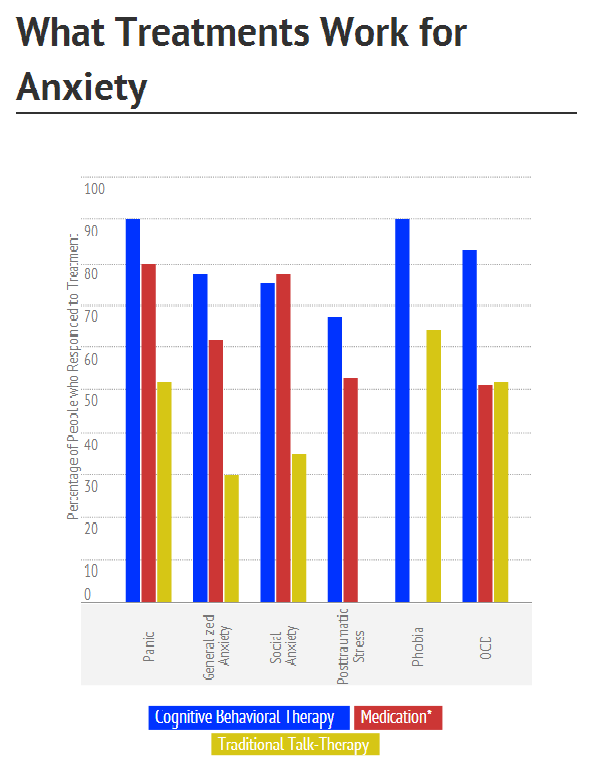
Over the last few decades, as the field of psychology has moved toward evidence-based practice, there has been some controversy about the increasing adoption of cognitive behavioral therapy (CBT) over other methods of treatment. Since increasing importance has been placed on treatments with research support, there has been a flood of new research available to guide clinicians and patients to the most effective treatments for psychological problems. In study after study, CBT stands out as the most effective treatment for numerous mental health issues. Furthermore, CBT treatments are usually of shorter duration, and the results are more enduring than those of other treatment methods. As a result, therapists trained in more traditional therapies, such as Freudian/psychodynamic therapists, have railed against this method of therapy because, they claim, it oversimplifies problems and aims toward a “quick fix” due to the shorter duration of treatment in CBT.

Below is a graph comparing the effectiveness of CBT with that of medication and other forms of talk therapy. Unfortunately, the research is not entirely definitive, as psychotherapy research is still in its relative infancy, not having the benefit of the bottomless pockets of big pharma. However, the initial research is striking in its implication of CBT being the treatment of choice for many psychological problems.


References:

Barlow, D.H., Gorman, J.M., Shear, M.K., & Woods, S.W. (2000). Cognitive-behavioral therapy, imipramine, or their combination for panic disorder: A randomized controlled trial. Journal of the American Medical Association, 283, 19, 2529-2536.

Bradley, R., Greene, J., Russ, E., Dutra, L., & Westen, D. (2005). A multidimensional meta-analysis of psychotherapy for PTSD. American Journal of Psychiatry, 162, 214-227.

Choy, Y., Fyer, A.J., & Lipstiz, J.D. (2007). Treatment of specific phobia in adults. Clinical Psychology Review, 27, 266-286.

Craske, M.G. & Barlow, D.H. (2008). Panic disorder and agoraphobia. In D.H. Barlow (Ed.) Clinical handbook of psychological disorders: A step-by-step treatment manual. (4th ed., pp. 1-64). New York: Guilford Press.

Eng, W., Roth, D.A., & Heimberg, R.G. (2001). Cognitive behavioral therapy for social anxiety disorder. Journal of Cognitive Psychotherapy, 15, 311-319.

Foa, E.B. & Kozak, M.J. (1997). Psychological treatment for obsessive-compulsive disorder. In M.R. Mavissakalian & R.G. Prien (Eds.), Long-term treatments of anxiety disorders (pp. 285-309). Washington, DC: American Psychiatric Press.

Ladouceur, R., Dugas, M.J., Freeston, M.H., Leger, E., Gagnon, F., & Thibodeau, N. (2000). Efficacy of a cognitive-behavioral treatment for generalized anxiety disorder: Evaluation in a controlled clinical trial. Journal of Consulting and Clinical Psychology, 68, 6, 957-964. 

What Causes Depression: Behavioral Causes

Over 16% of Americans experience clinical depression at some point during the course of their lives. Numerous recent studies have shed light on some of the biological factors that make someone predisposed to becoming depressed. However, not everyone with these genetic markers has depression. Environmental and behavioral factors dictate whether those latencies manifest during the course of one’s life. Below is a partial list of potential behavioral causes of depression, paired with their behavioral solutions.

Not having rewarding experiences: This can take numerous forms. Sometimes, people experience a significant loss, such as the loss of a loved one or losing a valued role at work. Without replacing the old source of reward with something new, people are significantly more likely to become depressed. Loss of reward can also take the form of not engaging in many rewarding activities. By not having enjoyable hobbies, going out with friends, or engaging in work that one finds meaningful, it is difficult to maintain an upbeat mood. Finally, not engaging in self-reward, such as praising oneself or treating oneself for a job well done, also falls into this category. The solution for all of these causes is to gradually and consistently increase behaviors that have the potential for reward. On the surface, this may seem like an easy fix, but it can be hard to find the motivation to expend energy when you are depressed. Luckily, a cognitive behavioral treatment is designed expressly for this purpose, called behavioral activation.

Not using problem-solving skills: When you encounter problems you feel you’re helpless to solve, you may be more vulnerable to depression. The more passive you become in the face of problems, the less likely it is that they will get solved. If your habit is to feel problems are hopeless and not do anything to solve them, you will end up leading a life in which you very seldom get what you want. The remedy is to change your orientation to problems, from being the victim of problems to being the solver of problems. If something doesn’t go right at work, brainstorm solutions and commit to one. If you don’t appreciate how someone treats you, assertively let them know and ask for what you want. If you don’t know the answer to a question, research the answer. Confronting difficult situations head-on with solutions is generally a more effective way of coping with them.

Changing Circumstances: The one thing that is constant in life is change. Big life changes, such as moving to a new city or becoming a parent, can require new learning and can sometimes make people feel unprepared or ill-equipped to handle life. One way to address this is to approach changes with some degree of acceptance, letting go of expectations. Turning the mind toward acceptance can help us be more willing to experience less-than-ideal circumstances and make the best of a difficult situation, using it as an opportunity to grow.

Feeling helpless: If you are in a situation in which you feel no matter what you do, you get the same unrewarding experiences, you may be more vulnerable to depression. People who feel this way often give up after a while, determining no matter what they do, they are powerless to change things for the better. If this is the case, it may be helpful to think about things differently. Bounce the situation off a few friends, and allow yourself to brainstorm all kinds of solutions, even those you couldn’t see yourself doing. Afterward, you may have a different perspective on how to fix things. Sometimes, very rarely, no matter how valiant our efforts are, some environments are just intransigent. In those cases, after you’ve exhausted every other strategy, it may be best to cut ties with that environment and find one that is more yielding.

Passivity: If you are not in the habit of asking for what you want, you are probably not in the habit of getting what you want. The less you get what you want, the less reason you have to feel happy. People are usually passive because they fear some negative consequence of speaking up. Usually, upon investigation, these negative consequences are unlikely and are more emotion-driven assumptions than facts. Many people are worried that if they are assertive with someone, that person will become angry or think less of them. The way to be more assertive if you are worried your relationship with the other person may be at risk is to examine these assumptions and determine how likely they are. Examining our thoughts somewhat objectively can be a very difficult task and requires the help of a trained cognitive therapist. Click here for more information on cognitive therapy for depression.  

Several behavioral causes of depression exist and have clinically researched and tested cognitive-behavioral remedies. Depression is a serious psychological problem. If you find yourself experiencing symptoms of depression, it is not recommended you go it alone by trying these techniques yourself, but seek the help of a trained cognitive behavioral psychologist. Cognitive behavioral therapy for depression is usually significantly shorter than traditional talk therapy, lasting only 12-20 sessions, and significantly more effective. Click here for more information about cognitive behavioral therapy


All material provided on this website is for informational purposes only.  Direct consultation with a qualified provider should be sought for any specific questions or problems.  Use of this website in no way constitutes professional service or advice. 

Acceptance Techniques to Reduce Anxiety and Worry

People who have difficulty controlling their anxiety generally worry a lot about a lot of things. This is known as generalized anxiety. One factor that often fuels generalized anxiety is difficulty accepting the absence of certainty. For most people, uncertainty about important areas of life is unpleasant. It may seem as though life would be easier if you knew how everything would turn out in advance. Unfortunately, this is not a realistic expectation. With life comes uncertainty. People who struggle with this often end up worrying about things they have very little control over, causing undue anxiety and stress.

A solution to fighting uncertainty… is simply accepting uncertainty. By choosing to tolerate not knowing how situations will turn out willingly, we expend less energy fighting unnecessary battles, and getting tied up in knots about things in ways that are unhelpful. Acceptance does not necessarily mean enjoying uncertainty. It merely means acknowledging that there is a degree of the unknown in everything we do and choosing not to fight this reality. Following are ways you can learn to turn your mind toward acceptance of uncertainty:

Weigh the pros and cons of accepting uncertainty: Identify the reasons fighting uncertainty feels helpful or safe, as well as the ways in which it is ineffective. Chances are the cons outweigh the pros. Being mindful of this can help you drop the struggle and embrace the unknown.

Identify areas of your life in which you’re already accepting of uncertainty: Chances are you’re already doing this, either with traffic jams along your commute, visiting a new restaurant, or meeting new people. Take a moment to consider how accepting some degree of uncertainty is helpful in these situations, and apply the same attitude with more challenging areas of your life.

Analyze what uncertainty means to you: Sometimes, we automatically associate uncertainty with a negative outcome without being aware of it. If you do this, take a step back from this thinking pattern and really identify whether there’s any evidence for this. Take another moment and identify the evidence against this assumption. Chances are, by thinking about uncertainty from this new perspective, it may seem less threatening and not necessarily negative.

Imagine what life would look like without uncertainty: Although a sense of certainty may be helpful for planning, it’s likely that too much certainty would make life pretty dull. How enjoyable would movies be if you knew exactly what was going to happen every step of the way? And with absolute certainty, there would be no pleasant surprises. Envisioning what would happen if we really got our wish and everything was more certain may cause us to think twice and consider that uncertainty comes with some benefits we normally overlook.

The next time you tense up when you encounter a feeling of uncertainty, bring to mind these different ways of relating to the situation and see what happens. You may find that you can more calmly handle whatever it is that’s on your plate, and you may just be able to appreciate some of the benefits of uncertainty.

This technique for reducing anxiety comes from a cognitive behavioral treatment for anxiety disorders that has been shown to be effective in significantly reducing symptoms of anxiety in 70-80% of patients (Durham, 1995). Compare that to traditional talk therapy, which helps about 30% of patients with generalized anxiety and takes twice as long. Click here for more information about cognitive behavioral therapy for anxiety disorders


Durham, R.C. (1995). Comparing treatments for generalized anxiety disorder: Reply. British Journal of Psychiatry, 166, 266-267.

All material provided on this website is for informational purposes only.  Direct consultation of a qualified provider should be sought for any specific questions or problems.  Use of this website in no way constitutes professional service or advice.